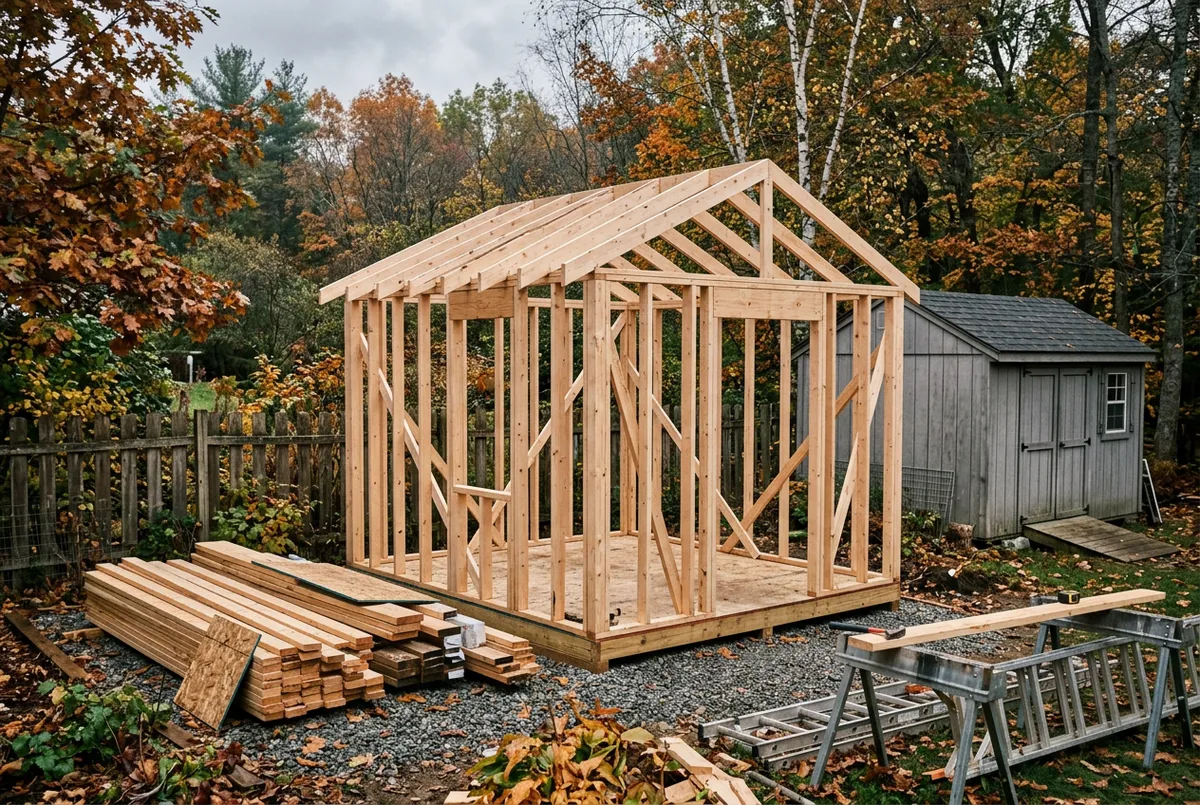
You have a corner of the yard that needs a roof over the mower, the tools and the garden supplies. A kit, a delivered shed and a lumber-yard build all look affordable until you add the pad, the delivery and your own hours. This guide lays out the published price ranges side by side, so you can see where the real money goes.
The short answer: For an 8x10 shed, published estimates put DIY materials at about $900-$2,300, mid-size wood kits at $1,200-$4,000, and a delivered or installed shed at roughly $2,400-$6,000+. Lumber is cheaper than a year ago, but the gap between build and buy is set more by your hours, your foundation, delivery and local permit rules. The ranges overlap, so treat every figure as an estimate and check your local code official before you commit.
All figures below come from retail and calculator sites, not measurements. Most of those pages show only the year 2026, so treat them as estimates. Nobody at this site built or priced out a shed for this guide.
What does it cost to build a shed yourself?
Published estimates for an 8x10 shed built from scratch put materials alone at roughly $900-$2,300, based on a table that lists 8x8 at $900-$1,500 and 10x10 at $1,500-$2,300 (it has no 8x10 row). Across sizes, DIY materials run about $12-$25 per square foot, and the framing package alone is budgeted at $12-$25 per square foot (Shedplans.org, 2026).
A calculator that assumes a gravel foundation, asphalt shingles and wood siding lands higher. It gives about $3,010 for a DIY 8x10 and about $3,390 for an 8x12, which is about $35 per square foot (Shed Calculator, 2026).
Why the gap? The lower figure counts lumber and basic materials. The higher one folds in the foundation, roofing and siding choices that most buyers end up making anyway. If you want a number to plan with, use the middle of the two and expect to land somewhere between $900-$3,010 for an 8x10, depending on what you include.
Tools matter too. A scratch build typically calls for a circular saw, a miter saw, a cordless drill and driver, a framing nailer or hammer, a 25 ft tape, a framing square, a 4 ft level, a chalk line and a post-hole digger (DIY Calc Tools). If you own none of these, borrowing or renting belongs in the budget.
What does a shed kit cost?
A wood kit is the middle path. You buy pre-cut parts and assemble them yourself. One published breakdown puts mid-size prefab kits (100 to 200 square feet) at $1,200-$4,000 (Backyard Oasis, 2026).
What does a delivered or installed shed cost?
Delivered and installed sheds cost more because you are paying for labor and shipping. The published figures vary by source:
- Delivered prefab 8x10: $2,400-$3,600 (Shed Builders Ready, 2026).
- Pre-built, delivered and installed 8x10: about $3,540-$4,230 (Shed Calculator, 2026).
- Delivered and installed, often: $3,000-$6,000+ (Veracity Estimating, 2026).
At the top end, one calculator shows a pre-built vinyl 8x10 at $5,946-$10,386 including a block foundation, a ramp and two windows (Project Cost Pro, 2026). That is an outlier, but it shows how options stack up.
How do the materials compare?
If you are still choosing between wood, metal, resin and vinyl, this installed-cost range across several sizes gives a rough ordering: resin $800-$2,500, metal $800-$3,500 and wood kit $2,000-$6,000 (Builds and Buys, 2026).
Lifespan estimates are less settled than price. One source gives wood 10-30 years, metal 20-30 years with care, resin 10-15 years and vinyl 10-35+ years depending on quality (Sheds Delivered, 2026). Other sources disagree. Keter, a resin maker, says a well-cared-for wood shed lasts 10-15 years (Keter). A resin-shed site puts budget plastic sheds at 5-7 years and mid-range resin at 10-15 years (Plastic Ranger). Given the spread, weigh your climate more than any single number, and note that some of these sources sell the products they compare.
Is lumber cheap enough to tip the balance?
Lumber has fallen, but the shed price is only partly lumber. Lumber futures were $525.03 per thousand board feet on 2026-10-20, down 1.87% over the month and 14.36% over the year. The same source ties the weakness to soft housing demand, homebuilder confidence at a 14-year low and 7.4% mortgage rates (Trading Economics, 2026-10-20).
The National Association of Home Builders reports a similar direction. Madison’s Lumber Price Index was $499.01 per thousand board feet on 2026-10-16, down 3.3% from a month earlier and 4.6% from a year earlier, while futures were down 13.4% year over year (NAHB, 2026-10-16).
Context helps. Futures hit about $642 in July 2026 and have since slid roughly 18% (Global Wood Markets Info, 2026-07). Preliminary Canadian softwood duties were cut to a combined 25.9%, but that figure is not final, and a 10% Section 232 tariff remains (NAHB, 2026-10-16). Trading Economics projects about $495.38 in 12 months, but that is a forecast, not a price you can count on.
What does that mean for your budget? Framing lumber is only part of a finished shed, since you also pay for roofing, siding, fasteners and the pad. A lower lumber price helps the DIY side, but it does not erase the other line items. Kit and installed prices are still $1,200 to $6,000+ for an 8x10 in the sources above.
What costs get left out?
Foundation, delivery and permits are the usual surprises. One breakdown lists an 8x10 at $1,500-$5,000 all-in, with foundation at $300-$2,000, delivery and assembly at $200-$1,500, and a permit at $100-$500 if one is triggered (Backyard Oasis, 2026).
Other add-ons from published summaries:
- Concrete slab: $6-$12 per square foot.
- Roofing: $300-$600 per 100 square feet.
- Gravel base: $4.50-$8.50 per square foot (MySitePlan, 2026).
Wiring is outside the scope of this guide. If you want power in the shed, hire a licensed electrician and ask your local code official what applies.
How much time and skill does a build take?
Time is the cost people forget to price. One guide puts a from-scratch build at 12-40 hours on average over several days, a small kit at 1-2 days and a professional install of a small shed at 3-8 hours. A helper cuts assembly time roughly in half. A gravel pad takes a few hours, while a slab adds several days to cure (Sheds Delivered, 2026).
Put a rough value on your weekends. Every hour you spend building is an hour you are not paying a crew for, so the real question is whether you enjoy the work, own the tools and have a helper for the wall raising.
Do you need a permit?
Often not for a small shed, but the rules are local. Cities commonly set the exemption line at 100, 120 or 200 square feet, and 120 is a frequent benchmark. Setbacks and lot coverage still apply to exempt sheds, and electrical, plumbing or a permanent concrete foundation usually trigger a permit (MySitePlan, 2026).
Local examples show how much this varies:
- Seattle measures its 120 square foot limit by projected roof area, not floor area (PermitsGuide, 2026).
Because an 8x10 is 80 square feet, it falls under many of these thresholds, but not all. Call or visit your local code official and your homeowners association, if you have one, before you buy or break ground.
What does the foundation require?
The pad is where a lot of budgets slip. A gravel pad should be at least 4 inches deep, 6 inches for larger sheds or soft ground, and about 2 ft bigger than the shed in each direction, so an 8x12 shed sits on a 10x14 pad. Heavy-duty woven fabric goes under the gravel. More than 8 inches of grade change across the footprint makes a gravel pad a poor choice (Build Blueprint).
Anchoring is the other half. Auger-style earth anchors suit gravel or soil bases, while concrete slabs need masonry anchors (Sheds Delivered, 2026). Fasteners matter outdoors as well, so exterior-rated deck screws are a sensible line item for any build or kit assembly.
For a sense of what else a yard project can cost, our guide to building a root cellar walks through four designs from $30 to $2,000, and our compost system guide shows how to price another yard build. If you are weighing other yard builds, the compost system comparison lays out the options side by side.
So which is cheaper, build or buy?
For a basic 8x10 on gravel, the published ranges overlap. DIY materials start near $900, a wood kit starts near $1,200, and delivered or installed sheds start around $2,400 and climb past $6,000. If you own the tools, have a helper and a flat site, building or assembling usually costs the least in cash. If your time is tight, the lot slopes, or you want a finished shed in a day, buying delivered often wins once hours and risk are counted.
Lumber, down about 14% over the year, nudges the DIY math in your favor this fall, but the more reliable levers are the foundation, delivery and permit questions above. Start with a call to your local code official, then price the pad, then compare the same size and roof across one kit, one delivered shed and one lumber list.
Your next step
Write down your target size, the pad you need and the number of weekend hours you can honestly spare. Then call your local code official about the permit threshold and setbacks, price an 8x10 three ways using the ranges above, and compare totals including delivery and foundation. Some builders start from a plan set with a printed lumber list. Exterior deck screws are worth buying in the right grade for the job. Pick the option whose total, not just its sticker price, fits your budget.
Frequently Asked Questions
- How much does it cost to build an 8x10 shed yourself?
- Published estimates put DIY materials for an 8x10 at about $900-$2,300 (published tables list 8x8 and 10x10 sizes, not 8x10). A calculator with gravel foundation, shingles and wood siding gives about $3,010.
- How much does a delivered and installed 8x10 shed cost?
- Sources range from about $2,400-$3,600 for delivered prefab to $3,540-$4,230 installed, and often $3,000-$6,000+. A high outlier with foundation, ramp and windows runs $5,946-$10,386.
- Are lumber prices low enough to make DIY cheaper now?
- Lumber futures were $525.03 per thousand board feet on 2026-10-20, down 14.36% over the year. That helps the DIY side, but foundation, delivery and permits shape the total more.
- Do I need a permit for a backyard shed?
- It depends on your locality. Cities commonly set the exemption line at 100, 120 or 200 square feet, and setbacks still apply. Check with your local code official before you build or buy.
- How long does it take to build a shed?
- One guide puts a from-scratch build at 12-40 hours on average over several days. A small kit takes 1-2 days, and a helper cuts assembly time roughly in half.
Sources & references
- Shedplans.org (opens in new tab)
- Shed Calculator (opens in new tab)
- DIY Calc Tools (opens in new tab)
- Backyard Oasis (opens in new tab)
- Shed Builders Ready (opens in new tab)
- Veracity Estimating (opens in new tab)
- Project Cost Pro (opens in new tab)
- Builds and Buys (opens in new tab)
- Sheds Delivered (opens in new tab)
- Keter (opens in new tab)
- Plastic Ranger (opens in new tab)
- Trading Economics (opens in new tab)
- NAHB (opens in new tab)
- Global Wood Markets Info (opens in new tab)
- MySitePlan (opens in new tab)
- MySitePlan permits (opens in new tab)
- PermitsGuide (opens in new tab)
- Build Blueprint (opens in new tab)
Before you go
The Renter's Homestead Pack
Self-reliance projects for the yard you don't own — container yields, a raised bed built to move with you, balcony preservation basics, and the landlord questions to ask first.
Free guide
The Renter's Homestead Pack
Self-reliance projects for the yard you don't own — container yields, a raised bed built to move with you, balcony preservation basics, and the landlord questions to ask first.