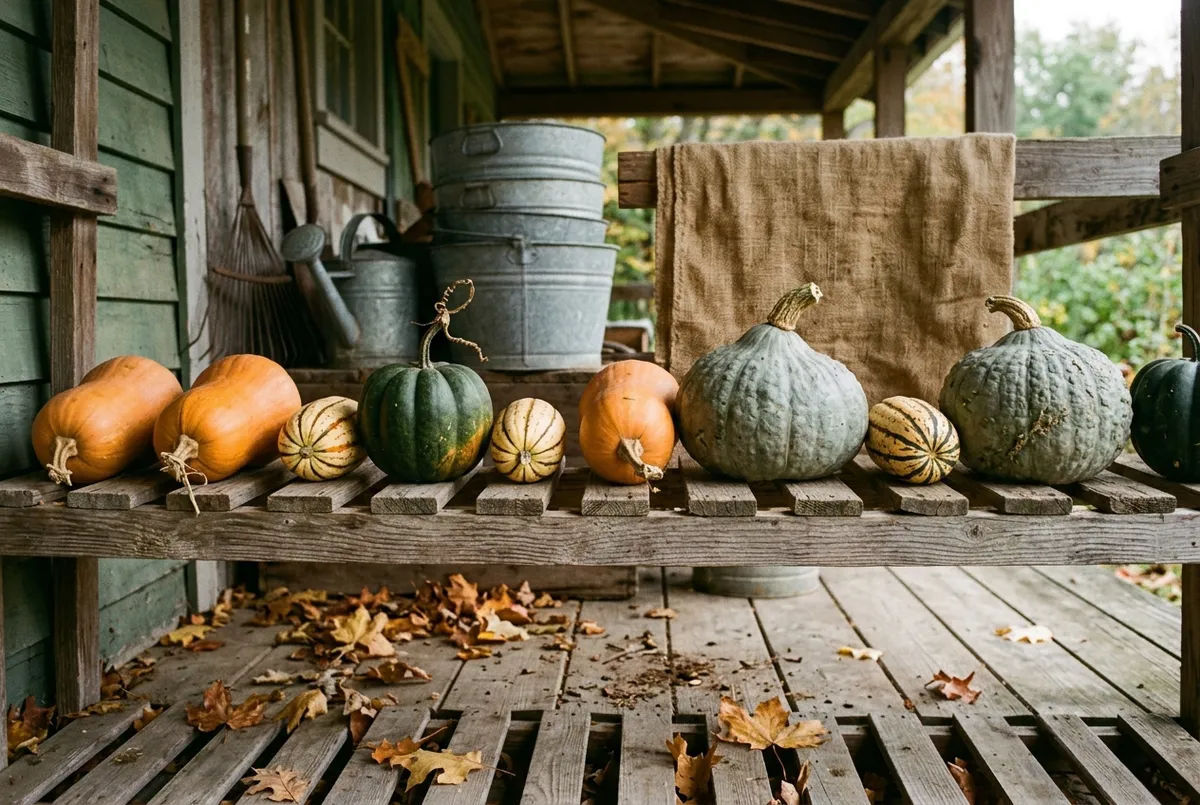
What’s the short answer?
- Cure most winter squash at 80-85°F and roughly 75-85% relative humidity for about 10 days after harvest; skip curing entirely for acorn types.
- Once cured, store at 50-55°F: acorn keeps 5-8 weeks, butternut 2-3 months, Hubbard 5-6 months.
- Curing adds no measured storage benefit for butternut, Hubbard, or Quality-type squash, per Alabama Cooperative Extension.
- Harvest before a full week of sub-50°F weather to avoid cold damage that shows up as rot weeks later.
- Cut with 2-4 inches of stem attached using a sharp knife or pruners; Hubbard is the exception and stores best with the stem removed.
Winter squash sits on the counter looking fine right up until the day it isn’t, a soft spot spreading from the stem end that means the inside has been quietly breaking down for a week or more. Most advice about handling a squash harvest treats every variety the same: cure it, then store it, done. Extension research shows something more specific than that, and the right approach changes depending on what’s actually sitting in the wheelbarrow.
The short answer: Cure most winter squash (acorn types are the exception) at 80-85°F and roughly 75-85% relative humidity for about 10 days after harvest, then move it to a cool space around 50-55°F. From there, storage life ranges from 5-8 weeks for acorn up to 5-6 months for Hubbard, depending entirely on the variety.
What curing actually requires: temperature and humidity
Curing is a deliberate step, not just letting a squash sit for a while. Alabama Cooperative Extension System describes it as holding squash at 80-85°F and 75-80% relative humidity for about 10 days, which heals surface wounds from harvest and lets immature fruit finish ripening (Alabama Cooperative Extension System, March 1, 2019). Iowa State University Extension and Outreach gives a nearly identical temperature target with a slightly wider humidity window, 80-85°F and 80-85% relative humidity, and specifies that this should happen right after harvest, before the squash goes into long-term storage (Iowa State University Extension and Outreach, Jan. 28, 2025).
In practice, that means a warm space with some humidity, not a cold shed or an open porch. A spare room with a space heater, a greenhouse on a mild fall day, or a warm section of a garage can all work if the temperature can be held and checked. The number that matters most is the low end: dropping below 80°F slows the wound-healing process, and the fruit stays vulnerable to rot organisms longer than it needs to.
A curing space doesn’t need to be elaborate. What it needs is a way to hold a stable temperature in the 80s and keep the air from drying out completely, since low humidity is part of what slows wound healing down. Spacing the fruit so individual squash aren’t touching, and checking every couple of days for any spot that’s gone soft, catches a problem before it spreads to whatever is sitting next to it.
Not every squash benefits from curing
This is where general advice tends to break down. Alabama Cooperative Extension’s variety-specific findings show that butternut, Hubbard, and Quality-type squash gained no added storage benefit from curing at all, and that curing actively harmed acorn-type squash such as Table Queen (Alabama Cooperative Extension System, March 1, 2019). Iowa State’s guidance points the same direction, applying curing to winter squash generally while calling out acorn types as the exception (Iowa State University Extension and Outreach, Jan. 28, 2025).
The practical rule is simple. Pumpkins get cured. Acorn squash skips curing entirely and moves straight to cool storage. Butternut, Hubbard, and Quality-type squash can be cured without harm, but it won’t buy extra weeks in the root cellar either. If shed or basement space is tight in October, curing those types is a reasonable place to cut a corner.
How long cured squash keeps, by variety
Once curing is done, or skipped for acorn, the fruit moves to cool storage, and this is where the variety differences get large. Iowa State puts storage life at 50-55°F at roughly 5-8 weeks for acorn, 2-3 months for butternut, and 5-6 months for Hubbard (Iowa State University Extension and Outreach, Jan. 28, 2025). Alabama Cooperative Extension’s post-cure chart gives comparable ranges with more detail on humidity:
- Acorn: 50°F, 50-75% relative humidity, 5-8 weeks. Storing acorn squash warmer than that produces poor color, so err toward the cooler end.
- Butternut, turban, and buttercup: 50°F, 50-75% relative humidity, 2-3 months.
- Hubbard: 50-55°F, 70-75% relative humidity, 5-6 months.
(Alabama Cooperative Extension System, ANR-1110, March 1, 2019)
The gap between acorn’s 5-8 weeks and Hubbard’s 5-6 months is the reason a mixed harvest needs to be sorted and tracked by variety rather than treated as one pile. If meals are being planned around what’s in storage, acorn squash needs to get eaten first, and Hubbard can genuinely wait until late winter.
Keeping a mixed harvest sorted by variety
A single harvest day can bring in acorn, butternut, and Hubbard squash side by side, and once they’re piled in a wheelbarrow or laid out on a tarp, it gets easy to lose track of which is which, especially among smaller acorn types that resemble other short-season squash at a glance. Labeling by variety before curing starts, even something as simple as a grease-pencil mark on the rind or a sorted crate for each type, heads off the two most common mistakes covered above: curing an acorn squash that should have gone straight to cool storage, or letting a fast-turnover variety sit forgotten behind slower-storing types until it’s already gone soft.
Harvest timing sets up everything that follows
Curing and storage only work as well as the harvest that precedes them. Oregon State University Extension Service recommends harvesting before temperatures drop below 50°F for more than a week, because squash left in cold, wet conditions past that point suffers cold damage or starts rotting once it’s in storage (Oregon State University Extension Service, Aug. 2023). That means watching the forecast in early fall rather than waiting for a hard frost to force the decision. A squash that looked fine coming off the vine can already carry cold damage that only shows up as soft spots weeks into storage, well after curing has come and gone.
This is also where the “beyond just pumpkins” part of a mixed garden matters. Pumpkins tend to get harvested with fanfare on a specific day. Butternut, acorn, and Hubbard vines are easy to lose track of in the same bed, and a week of cold nights can quietly damage fruit that was otherwise ready to come in.
How the cut affects how long it lasts
The stem is a small detail with an outsized effect on storage life. Oregon State’s guidance is to cut fruit from the vine with 2-4 inches of stem still attached, using a sharp knife or pruners rather than twisting or pulling it off (Oregon State University Extension Service, Aug. 2023). A torn or broken stem leaves an open wound right at the point where rot organisms get in fastest, and it’s one of the more common, avoidable causes of a squash going soft within the first few weeks in storage.
Hubbard squash is the one exception to this rule. Rather than leaving a long stem, Hubbard-type squash stores best with the stem removed entirely (Oregon State University Extension Service, Aug. 2023). It’s a small enough detail that it’s easy to miss when harvesting a mixed bed on the same afternoon and handling every fruit the same way.
Whatever tool ends up doing the cutting, a clean edge matters more than the specific tool. A dull blade that crushes rather than cuts leaves a ragged wound that takes longer to heal and gives rot organisms more surface area to work with, on top of whatever the stem length does or doesn’t do for a given variety.
Why squash rots a few weeks after harvest
When squash goes soft in storage well before its expected shelf life runs out, the cause is almost always one of three things covered above: it was harvested after a stretch of cold, wet weather; it was cured when it shouldn’t have been, as with acorn types; or the stem tore during harvest instead of being cut cleanly. None of these show up as a problem on day one. They show up weeks later, which is exactly why the storage space tends to get blamed instead of the harvest and curing steps that actually caused it.
Cold damage is the hardest of the three to see coming, since a squash that sat through several nights in the 40s can look completely normal at harvest and only start breaking down once it’s been in storage a few weeks. An acorn squash that got cured when it should have skipped straight to cool storage tends to show up as a fruit that goes soft and loses its color faster than its usual window would suggest, since curing is working against it rather than for it. A torn stem is usually the easiest of the three to catch early, since the wound is visible right at harvest rather than hidden inside the flesh until it’s too late to do anything about it.
The fix isn’t a different storage location. It’s working back through harvest timing, curing decisions, and stem handling, variety by variety, and matching each one to what the extension data actually says it needs rather than running every squash through the same routine.
None of this requires special equipment. A thermometer to confirm the curing space is actually holding in the 80s, a notebook or a few grease-pencil marks to track variety and harvest date, and a cool room or unheated closet that stays steady in the 50s for storage cover the whole process. What changes the outcome is applying the right combination of curing, temperature, and stem handling to each variety instead of running everything through one routine.
What to do with this season’s harvest
Sort what’s coming off the vine by variety before deciding on curing at all: pumpkins and most non-acorn types go into a warm, humid space for about 10 days, while acorn squash skips straight to cool, moderate-humidity storage. From there, track shelf life by variety rather than by harvest date, since acorn needs to get worked into meals within weeks while Hubbard can sit for months. Anyone weighing whether to grow more of this kind of food storage next season might find it worth checking what a dedicated backyard growing system can realistically add to a harvest like this one (Backyard Liberty Review), and pairing that decision with the kind of off-season prep covered in 5 Backyard Homestead Projects for Slow Winter Weeks.
Frequently Asked Questions
- What temperature should I cure winter squash at before storing it?
- Around 80-85°F. Alabama Cooperative Extension puts the humidity at 75-80% for about 10 days, while Iowa State University Extension and Outreach gives a slightly wider 80-85% humidity window right after harvest.
- How long does butternut squash actually keep in storage?
- About 2-3 months once cured and held at 50-55°F, according to Iowa State University Extension and Outreach and Alabama Cooperative Extension System, which lists the same range at 50°F and 50-75% relative humidity.
- Can I store acorn squash the same way as butternut or Hubbard?
- No. Alabama Cooperative Extension found curing actively harms acorn types, so they should skip curing and go straight to storage. Acorn also keeps far less time, about 5-8 weeks, versus 2-3 months for butternut and 5-6 months for Hubbard.
- Why is my winter squash rotting a few weeks after harvest?
- The usual causes are harvesting after a stretch of cold, wet weather below 50°F; curing an acorn squash that should have skipped curing; or a torn stem from harvest instead of a clean cut with 2-4 inches left attached.
- Do I need to cure every type of winter squash, or just pumpkins?
- Not every type. Alabama Cooperative Extension reports no added storage benefit from curing butternut, Hubbard, or Quality-type squash, and Iowa State University Extension and Outreach notes that curing reduces acorn squash's quality and storage life.
Sources & references
Before you go
The Renter's Homestead Pack
Self-reliance projects for the yard you don't own — container yields, a raised bed built to move with you, balcony preservation basics, and the landlord questions to ask first.
Free guide
The Renter's Homestead Pack
Self-reliance projects for the yard you don't own — container yields, a raised bed built to move with you, balcony preservation basics, and the landlord questions to ask first.