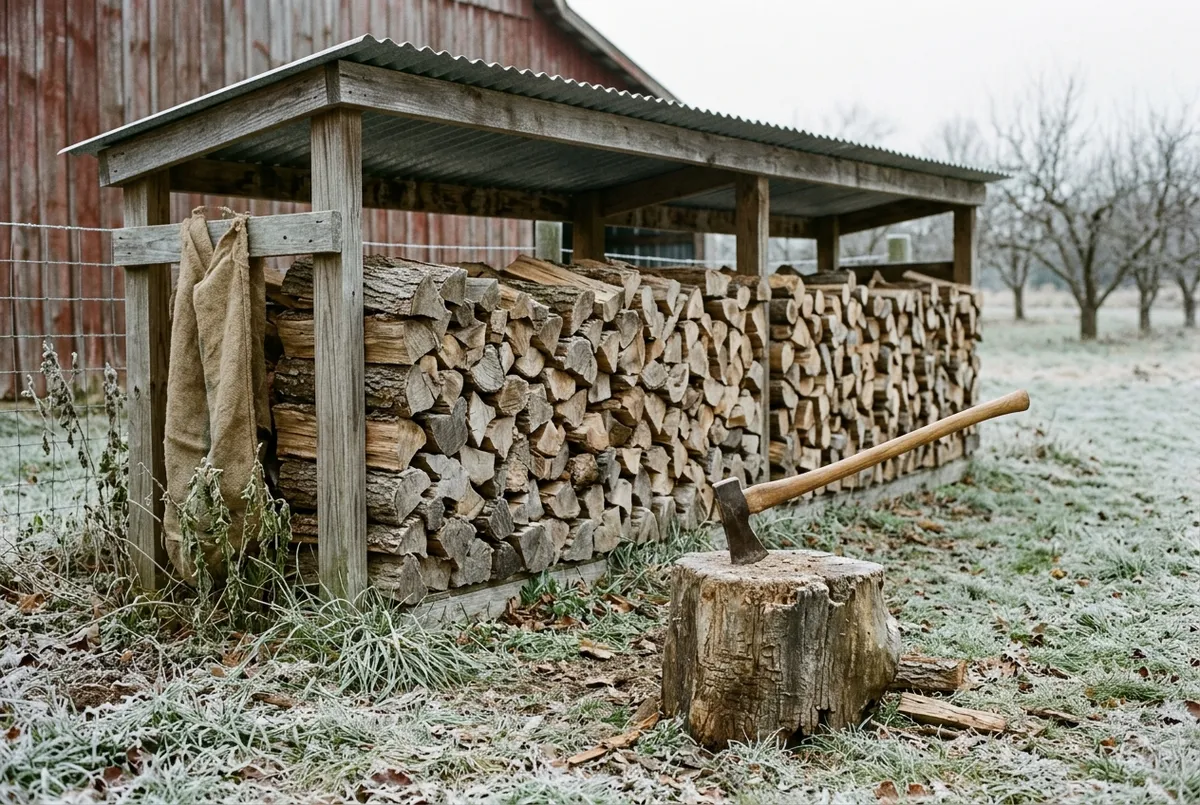
What’s the short answer?
- A full cord is a 4x4x8-foot stack (128 cubic feet), but actual solid wood inside it runs closer to 65-90 cubic feet, averaging about 80 in the Midwest (University of Missouri Extension, 2025).
- Homes burning wood as primary heat in Michigan and the northern Lake States typically need about five to six cords per winter, though usage varies widely by house (Michigan State University Extension, 2012 baseline).
- One cord of air-dried hardwood holds about 11.4 million available Btu at 50 percent stove efficiency (University of Missouri Extension, 2025).
- A 60,000-Btu wood or pellet unit can heat up to about 2,000 square feet; a 42,000-Btu unit covers roughly 1,300 square feet (University of Missouri Extension, 2025).
- Face cords and ricks (roughly 48-64 cubic feet) are often sold as cords, University of Missouri Extension warns, so verify delivered wood by stacking it in true 4x4x8-foot dimensions (University of Missouri Extension, 2025).
You bought a truck-bed load of wood back in October, burned through it by February, and spent the coldest six weeks of the year paying gas-station prices for bundled logs. Or you’re standing in front of a wood lot right now trying to decide whether four face cords is plenty or nowhere near enough. Either way, guessing gets expensive fast, and the seller measuring your wood has no reason to round in your favor. A woodpile always looks bigger standing next to it in the fall than it does after the first hard freeze sets in.
The short answer: Most homes burning wood as a primary heat source need somewhere around five to six full cords for one winter in a colder northern climate, though the real number for your house depends on square footage, insulation, stove efficiency, and how many hours a day you’re actually burning. The math below shows you how to size that number for your own setup instead of guessing, and how to make sure the wood you buy is a real cord in the first place.
How many cords of firewood do you actually need for one winter?
Wood heat is more common than it might feel like standing in a big-box store’s fireplace aisle. About 2.5 million U.S. households use wood as their main home-heating fuel, and another 9 million use it as a secondary or backup source, together accounting for roughly 500 trillion Btu of residential wood use a year (U.S. Energy Information Administration, March 2014, based on 2005/2012 Census data). You’re not the only one doing this math every fall.
The most concrete per-winter figure available comes from Michigan State University Extension, which puts it plainly: “Most homes will require about five or six cords per winter” in Michigan and the broader northern Lake States climate (Michigan State University Extension, 2012 baseline). That figure covers a typical home using wood as its primary heat source through a full cold season, and MSU is explicit that it varies widely by house.
Treat five to six cords as an anchor point for a colder northern climate and a house using wood as primary heat, not a number that transfers exactly to your address. A smaller, well-insulated home, a milder winter, or a stove that only supplements a furnace on the coldest nights will burn through less. A drafty older farmhouse relying on wood alone, in a harsher climate, can burn through more. There is currently no published federal chart that breaks per-winter cord needs down by climate zone, so the honest answer is to start from a real regional data point like MSU’s and adjust it against your own square footage and stove size, which the next two sections walk through.
Two households in the same county can land on very different totals for reasons that have nothing to do with the weather outside. How many hours a day the stove actually runs, whether it’s the sole heat source or backup to a furnace, how tight the house’s insulation and air sealing are, and even how consistently the wood gets fed at a steady burn rather than in occasional big loads, all shift the season’s total up or down. That’s part of why a single national number would be misleading even if one existed: the honest range is a starting estimate you refine against your own house over your first season or two of tracking actual usage.
What exactly counts as a “cord,” and how is that different from a face cord or a truckload?
A standard cord is a legal, defined unit: wood stacked bark and all, four feet high, four feet wide, and eight feet long, totaling 128 cubic feet of stacked space (University of Missouri Extension, 2025). That 128 cubic feet includes the wood plus the air gaps between irregular pieces, which is the detail most buyers miss. The actual solid wood inside a full cord runs closer to 65 to 90 cubic feet, averaging around 80 cubic feet in the Midwest, once you subtract the empty space.
That gap between stacked volume and solid wood volume is exactly why a “face cord” or a “rick” is not the same thing as a full cord, even though sellers sometimes use the terms loosely. A face cord is typically one row of wood, still four feet high and eight feet long, but only as deep as the pieces are long rather than the full four feet. With the 18-to-24-inch widths University of Missouri Extension describes, that works out to roughly 48 to 64 cubic feet: no more than half of a true cord, and often less.
A “truckload” isn’t a standard unit of measurement at all. It depends entirely on the size of the truck bed and how tightly the wood is thrown in, so two “truckload” deliveries from two different sellers can vary enormously in the actual volume of wood you get.
How much heat is actually in a cord of firewood?
Assuming your five-to-six-cord estimate from the first section is even roughly right for your climate, the next question is how far that wood actually goes toward keeping your house warm. One cord of air-dried hardwood firewood, at around 20 percent moisture content, contains about 11.4 million available Btu, calculated at a realistic 50 percent wood-stove operating efficiency (University of Missouri Extension, 2025).
That efficiency figure matters as much as the raw Btu number. Green or wet wood that hasn’t been seasoned down to that roughly 20 percent moisture range burns less efficiently, produces more smoke and creosote, and delivers noticeably less usable heat per cord than the seasoned wood the 11.4 million Btu figure assumes. If your wood came off the truck damp or was cut earlier that same year, plan on needing more of it, or on giving it real time to dry before it becomes your primary heat source.
Multiplying that 11.4-million-Btu figure by the five-to-six-cord range from the first section gives a rough season total: on the order of 57 to 68 million available Btu of usable heat across a winter, at that same 50 percent stove efficiency. That’s a ballpark, not a guarantee, since it inherits the uncertainty of both numbers it’s built from, but it’s a useful sanity check once you’ve bought wood and want to know whether the pile in your yard is in the right neighborhood for the season ahead, rather than finding out in February.
What size wood stove do you need for your square footage?
Buying enough wood only pays off if your stove can actually turn that fuel into heat for the space you’re trying to warm. As a sizing benchmark, a wood- or pellet-burning unit rated at 60,000 Btu can heat up to a 2,000-square-foot home, while a smaller 42,000-Btu unit covers roughly 1,300 square feet (University of Missouri Extension, 2025).
Those two data points give you a rough per-square-foot ratio to work from: somewhere around 30 to 33 Btu per square foot of rated stove output for a home in a similar climate. A stove that’s undersized for your square footage runs flat-out on the coldest nights and still leaves rooms cold, which pushes you toward burning more wood than the estimates above account for. A stove that’s oversized runs at a low, inefficient smolder most of the time to avoid overheating the house, which wastes wood a different way. Matching stove size to square footage before you calculate your winter’s wood supply keeps the cord estimate in the first section closer to reality.
If part of your winter plan also depends on running blowers, fans, or a carbon monoxide detector during outages, that’s a separate power question from the wood itself; our 300W vs. 1000W solar generator comparison walks through sizing backup power the same way this article sizes wood.
Is buying wood by the truckload a ripoff compared to a real cord?
Not necessarily, but it can be, and the burden is on you to check. Because a face cord or rick can run less than half the volume of a true cord, and a “truckload” has no fixed definition at all, Missouri Extension is direct about the risk: ricks are often sold as cords, so buyer beware (University of Missouri Extension, 2025).
The fix is measurement, not trust. When wood is delivered, stack it yourself, or watch it get stacked, in the 4-foot-by-4-foot-by-8-foot dimensions that define a legal cord, and see how close the actual stacked volume comes to 128 cubic feet. If a seller is unwilling to describe a delivery in cord or fraction-of-a-cord terms, or gets vague when you ask, that’s worth treating as a signal on its own. Comparing sellers by price per verified cord, rather than by price per vague “load” or “truckload,” is the only way to know whether you’re actually getting a deal or getting shorted on volume before the wood is even stacked.
Splitting and stacking a real cord is also a fall project worth planning time for rather than squeezing in during the first cold snap; if you’re mapping out what else needs doing before the ground freezes, our roundup of homestead projects for slow winter weeks covers what else tends to get pushed off until it’s too late.
Turning your yearly heat need into cords
Oregon State University Extension describes a calculation that starts from the heat your home already uses (Oregon State University Extension Service, November 2013). It takes three steps. Multiply the wood’s heat value per cord by your stove’s efficiency to get available heat per cord. Divide 1 million by that number to get cords per million Btu. Then multiply by the Btu your home needs for the year, counted in millions.
The publication’s worked example is a home using 600 therms of gas a year, which means 48,000,000 Btu of available heat. Douglas-fir at 21,000,000 Btu per cord and 70 percent efficiency gives 14,700,000 available Btu per cord, so that home needs 3.264 cords a year.
Its species table assumes a cord of 85 cubic feet of solid wood at 20 percent moisture, burned in an airtight stove at 60 percent efficiency. Oregon white oak is listed at 30,000,000 Btu per cord and ponderosa pine at 17,000,000. New EPA-approved stoves are at least 60 percent efficient, and some are as much as 80 percent.
What to do with this before the cold sets in
Start from the anchor: five to six cords for a typical primary-heat home in a colder northern climate, adjusted down for a smaller or better-insulated house and adjusted up for a drafty one or a harsher winter. Confirm your stove is sized to your square footage using the 60,000-Btu-to-2,000-square-foot ratio above, since an undersized or oversized stove throws off every wood estimate built on it. Then, when you buy, insist on cord or fraction-of-a-cord language and check the stacked dimensions yourself rather than accepting “truckload” as a unit of measure. If firewood is one line item in a bigger fall budget alongside canning, storm prep, and other seasonal costs, our guide to setting a realistic homestead budget is a reasonable next stop for putting the wood number in context with everything else on the list.
Frequently Asked Questions
- How many cords of firewood do I need for one winter?
- Most homes burning wood as a primary heat source in Michigan and the broader northern Lake States climate need about five to six cords per winter, according to Michigan State University Extension, though the real number varies widely by house, insulation, and how many hours a day the stove runs.
- What exactly counts as a cord, and is that different from a face cord or a truckload?
- A full cord is a legally defined stack 4 feet high, 4 feet wide, and 8 feet long, totaling 128 cubic feet, with actual solid wood inside running closer to 65-90 cubic feet. A face cord or rick is typically 4 feet high, 8 feet long and only 18-24 inches deep, roughly 48-64 cubic feet, half a full cord or less. A truckload has no standard volume at all.
- How much heat is actually in a cord of firewood?
- One cord of air-dried hardwood at about 20 percent moisture contains roughly 11.4 million available Btu, calculated at 50 percent wood-stove operating efficiency, per University of Missouri Extension.
- What size wood stove do I need for my square footage?
- As a benchmark, a 60,000-Btu wood or pellet unit can heat up to about 2,000 square feet, while a 42,000-Btu unit covers roughly 1,300 square feet, per University of Missouri Extension. Actual coverage still depends on insulation and house layout.
- Is buying wood by the truckload a ripoff compared to a real cord?
- It can be. University of Missouri Extension warns that ricks are often sold as cords, and a truckload has no fixed volume, so stacking delivered wood in true 4x4x8-foot cord dimensions is the way to check what you got rather than trusting a seller's label.
Sources & references
- University of Missouri Extension, Wood Fuel for Heating (G5450) (opens in new tab)
- Michigan State University Extension, Maximize Your Wood-Heating Investment (opens in new tab)
- U.S. Energy Information Administration, Today in Energy (opens in new tab)
- Oregon State University Extension Service, Home Heating Fuels (EC 1628) (opens in new tab)
Before you go
The Renter's Homestead Pack
Self-reliance projects for the yard you don't own — container yields, a raised bed built to move with you, balcony preservation basics, and the landlord questions to ask first.
Free guide
The Renter's Homestead Pack
Self-reliance projects for the yard you don't own — container yields, a raised bed built to move with you, balcony preservation basics, and the landlord questions to ask first.