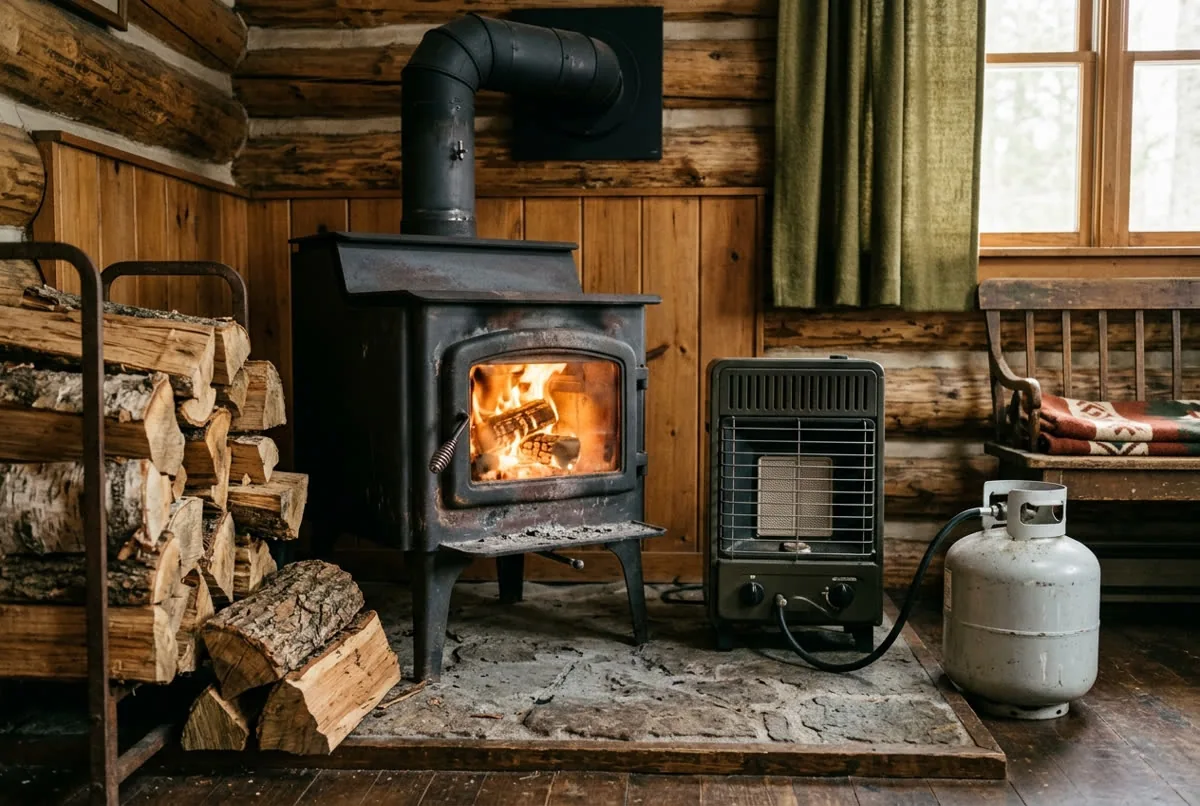
What’s the short answer?
- An unlisted radiant wood stove needs 36 inches from unprotected combustible walls under the 2003 edition of NFPA 211; a circulating stove needs 12 inches at the sides and rear and 24 inches in front. Listed stoves follow the manufacturer's instructions.
- Stovepipe needs 18 inches of clearance to combustibles in the same NFPA 211 summary; reduced clearances apply only where the combustible surface is protected as NFPA 211 describes.
- CPSC documented 12 carbon monoxide incidents (18 deaths) from portable propane radiant heaters used in tents, campers, trailers and vehicles.
- CPSC recommends a CO alarm outside the bedrooms in each separate sleeping area; FEMA says never to use a propane heater indoors.
- A wood stove chimney should extend at least 3 feet above the roof and 2 feet above any roof surface within 10 feet (NFPA 211-2016 reprint).
Your off-grid cabin or shed keeps the summer solar setup running fine, but winter asks a different question: something has to generate heat, and the backup power you already have was never sized to run a space heater all night long. Wood and propane are the two realistic off-grid heat sources once the electric grid isn’t an option, and each one asks something different of your space, your fuel supply, and your attention. Neither option wins by default.
The short answer: A wood stove is the stronger long-term choice if your space has the clearance and chimney height to install one to code, because once it’s installed right it needs no fuel deliveries. A portable propane heater is a possible short-term or supplemental choice for a tight space only where its manufacturer permits indoor use, paired with a battery-operated CO alarm and never left running unattended overnight; FEMA’s winter tips say never to use a propane heater indoors.
Which Is Safer in a Small Off-Grid Cabin: A Wood Stove or a Propane Heater?
The honest answer is that “safer” depends on which failure mode you’re better positioned to avoid, because the two options fail in different ways.
A portable propane heater’s main hazard is carbon monoxide. CPSC staff investigated 12 incidents between 1996 and June 2001 involving portable propane radiant heaters; they resulted in 18 deaths from CO poisoning, all in tents, campers, trailers or motor vehicles (CPSC, 2002). The report says these heaters are intended for large open areas with enough air for combustion, and become a CO hazard when operated in small, poorly ventilated enclosed spaces. A tightly sealed cabin or shed is the same kind of space.
A wood stove doesn’t put that same CO load into the room when it’s vented correctly through a proper chimney. Its hazard shows up differently: fire risk from combustibles sitting inside the clearance a stove actually requires. The 2003 edition of NFPA 211, as summarized by the Maine Office of State Fire Marshal, sets that clearance at 36 inches from unprotected combustible walls for an unlisted radiant stove; a circulating model is allowed 12 inches at the sides and rear and 24 inches in front (Maine Office of State Fire Marshal guide, 2003). Listed stoves are installed according to the manufacturer’s instructions instead.
Neither hazard is solved by general caution alone. FEMA’s winter-readiness toolkit lists home heating fires and carbon monoxide poisoning among the common cold-weather risks, and its tips say to keep anything that can burn at least 3 feet from a fireplace, wood stove or space heater and never to use a propane heater indoors (FEMA, 2024). So the practical version of “which is safer” is: a wood stove is safer once it’s installed to the clearance and chimney specs below and maintained; a propane heater is safer when it’s never run without ventilation and a working CO alarm nearby, and only where its manufacturer allows indoor use. Skip either condition and the numbers stop mattering.
How Much Clearance Do You Really Need Around a Wood Stove?
This is where small-cabin and shed plans can run into trouble, because the clearance math is stricter than it looks on a floor plan sketch.
For the stove body itself, the 2003 edition of NFPA 211 sets baseline clearances at 36 inches from unprotected combustible walls for an unlisted radiant stove. A circulating stove, which has an outer jacket with openings so room air passes between the stove and the jacket, is allowed 12 inches at the sides and rear, 24 inches in front and 36 inches to the ceiling (Maine Office of State Fire Marshal guide, 2003). Nationwide’s reprint of an NFPA 211-2016 table pairs a 36-inch wall clearance with an 18-inch ceiling clearance, so confirm the ceiling figure for your stove with its manual and your local code official. That difference alone can decide whether a stove fits in a small structure at all.
The stovepipe has its own clearance rules, separate from the stove body. The Maine guide’s table lists 18 inches of clearance to combustibles for a stovepipe, and its connector section states the same rule as not less than three times the connector’s diameter, reducible where the combustible material is protected as NFPA 211 describes (Maine Office of State Fire Marshal guide, 2003). Nationwide’s NFPA 211-based bulletin likewise calls for a minimum 18-inch clearance where a stovepipe passes through an exterior wall (Nationwide Loss Control Services, 2018).
The floor needs its own protection too. The Maine guide says that where a stove sits on a noncombustible base such as a concrete slab or masonry arch instead of floor protection, that base must extend not less than 18 inches beyond the appliance on all sides, and it ties the protection required on a combustible floor to the length of the stove’s legs (Maine Office of State Fire Marshal guide, 2003). Nationwide’s bulletin adds that stoves should always be installed according to the manufacturer’s specifications, and that if the manufacturer’s or local code requirements differ, the stricter ones should be followed (Nationwide Loss Control Services, 2018). None of these numbers are negotiable by eye. A stove that “looks” far enough from the wall isn’t the same as one measured to spec, and the difference is exactly the margin these clearances exist to protect.
What a Wood Stove Needs Beyond Clearance: Chimney Height and Draft
Clearance gets a stove installed. Chimney height is what keeps it drafting correctly and burning clean once it’s running.
Guidance reprinted from NFPA 211-2016 calls for the chimney to extend at least 3 feet above the point where it passes through the roof, and at least 2 feet above any roof surface within 10 feet horizontally (Nationwide Loss Control Services, 2018). The Maine guide gives the 2-foot rule as what a chimney needs for sufficient draft (Maine Office of State Fire Marshal guide, 2003), and University of Idaho Extension notes that most creosote problems come from chimneys with a low draft and cold walls (University of Idaho Extension).
This is an easy step to skip on a shed or small cabin, because it’s tempting to route the pipe out the nearest wall or through the lowest point of the roof to save pipe length. That shortcut works against the stove instead of for it. If your roofline, nearby trees, or an adjacent structure make it hard to hit that height and clearance combination, that’s a real constraint on whether a wood stove is the right fit for that specific building, not just a detail to work around later.
Can You Run a Portable Propane Heater Overnight in a Tiny Home?
This is the question that matters most if a propane heater is your plan, and the evidence here doesn’t support a simple yes.
CPSC’s investigation into CO emissions from portable propane radiant heaters documented incidents specifically tied to poorly ventilated use in small enclosed spaces, the same category a tiny home or single-room cabin falls into (CPSC, 2002). The ANSI Z21.63 camp-heater standard, revised in 2000, requires that when a heater is operated in a 100-cubic-foot room at 0.5, 1.0 and 1.5 air changes per hour, CO cannot exceed 100 ppm and oxygen cannot fall below 16 percent. CPSC tested eight heaters against that requirement: none of the six without an oxygen depletion sensor complied (the worst reached 2,124 ppm), while the two sensor-equipped heaters shut off before CO reached 100 ppm (CPSC, 2002). Those are lab results in a small test chamber, not a guarantee for a sealed-up tiny home.
The CPSC report is about camp-style heaters in small enclosed spaces and doesn’t set an overnight rule, while FEMA’s #WinterReady tips say never to use a gasoline or propane heater indoors (FEMA, 2024). Neither source supports leaving a propane heater running while everyone sleeps. If a heater’s manufacturer does allow indoor use, follow its ventilation and shut-off instructions exactly, and keep a working CO alarm outside the sleeping area, as CPSC recommends (CPSC, December 2005).
What CO Detection and Ventilation Does Each Option Need?
Both heat sources need a CO alarm in the building. The reasons differ.
A propane heater’s CO output goes directly into the room it’s heating unless that room is adequately ventilated. The ANSI Z21.63 limit is tested in a 100-cubic-foot chamber at set air-exchange rates, so it tells you how a heater behaves under those conditions, not in your room (CPSC, 2002). Ventilation is an active condition you maintain every time you run the heater, not a one-time install step.
A wood stove that’s vented correctly through a chimney meeting the height and draft requirements above shouldn’t be adding CO to the room during normal operation. The alarm still matters because CPSC says fuel-burning appliances can cause carbon monoxide poisoning if they are improperly installed, poorly maintained, or have defective or blocked venting systems, and it recommends a CO alarm outside the bedrooms in each separate sleeping area (CPSC, December 2005). FEMA’s winter tips also name carbon monoxide poisoning and home heating fires among the common cold-weather risks (FEMA, 2024). A battery-operated alarm suits an off-grid setup, since a plug-in-only alarm goes dark in a power outage.
How Should You Think About Fuel Sourcing and Storage for Wood vs. Propane?
The sources don’t put numbers on this part, so the honest version stays qualitative, but the shape of the tradeoff is still worth laying out.
Wood asks for space and lead time. Dry, seasoned wood needs a covered, ventilated storage area, and that storage area has to sit outside the stove’s own clearance zone rather than crowding it, which defeats the point of measuring that clearance in the first place. Sourcing is often local and low-cost if you’re already managing a wooded lot, but it isn’t instant; wood cut and stacked this month isn’t ready to burn well this month.
Propane asks for logistics instead of lead time. A tank has to be filled or exchanged, which means a supply chain you don’t fully control once weather or road conditions get bad, and the tank itself needs its own storage clearance from ignition sources, separate from whatever clearance the heater needs when it’s running. The upside is that propane is ready to burn the moment the tank is connected, with no seasoning or drying involved.
Neither pattern is universally better. A property with wooded acreage and time to season fuel a season ahead leans toward wood. A property without the space for a stove installation, or a need for occasional supplemental heat rather than a full-time system, leans toward propane with the ventilation and alarm conditions above treated as non-negotiable rather than optional.
Where This Fits With the Rest of Your Off-Grid Winter Plan
Heat source is one piece of a larger winter equation, and it’s worth sizing it against the rest of what’s already keeping your space warm. A DIY storm window insulation kit reduces how hard either a wood stove or a propane heater has to work in the first place, which changes the fuel math on both sides of this comparison.
The next step is to measure your actual structure before choosing anything. Walk the space where a stove would go and check whether the clearances for your stove actually fit (36 inches to the nearest combustible wall for an unlisted radiant stove, 12 to 24 inches for a circulating model, or whatever the manual says for a listed one), with room left for the floor protection and stovepipe clearance, and separately check whether your roofline can support a chimney that clears 3 feet above the roof and 2 feet above anything within 10 feet. If that math doesn’t work for your building, a propane heater becomes the realistic option, and the next step there is installing a battery-operated CO alarm and confirming real ventilation before the first night you run it, not after.
Frequently Asked Questions
- Is a wood stove or a propane heater safer for a small off-grid cabin?
- Each carries a different hazard. A portable propane heater's main risk is carbon monoxide buildup in a poorly ventilated space, which the CPSC has documented in real incidents involving tents and trailers. A wood stove's main risk is fire, whether from combustibles placed inside its required clearance zone or from a neglected chimney. Neither risk goes away through general caution; both need the specific safeguards covered below.
- How much clearance does a wood stove need from combustible walls?
- Under the 2003 edition of NFPA 211, as summarized by the Maine Office of State Fire Marshal, an unlisted radiant wood stove needs 36 inches of clearance from unprotected combustible walls. A circulating stove needs 12 inches at the sides and rear and 24 inches in front. Stovepipe needs its own clearance of 18 inches, and listed stoves should be installed according to the manufacturer's instructions, with the stricter of the manufacturer's or local code requirements followed.
- Can I run a portable propane heater overnight in a tiny home?
- CPSC investigated 12 incidents between 1996 and June 2001 in which portable propane radiant heaters used in poorly ventilated small enclosed spaces such as tents, campers and trailers led to 18 carbon monoxide deaths. FEMA's #WinterReady tips say never to use a propane heater indoors. The ANSI Z21.63 camp-heater standard caps CO at 100 ppm in a 100-cubic-foot test room, and in CPSC's lab tests only the heaters with an oxygen depletion sensor met it.
- What carbon monoxide detection do I need with a wood stove or propane heater?
- CPSC recommends a carbon monoxide alarm outside the bedrooms in each separate sleeping area, in addition to smoke alarms on each level of the home. A propane heater is a direct CO source in a sealed space; a wood stove calls for one too, because CPSC says fuel-burning appliances can cause CO poisoning when venting systems are defective or blocked, even though a properly vented stove does not add CO to the room under normal operation.
- How tall does a wood stove chimney need to be?
- Chimney height affects draft. Guidance reprinted from NFPA 211-2016 calls for the chimney to extend at least 3 feet above the point where it passes through the roof and at least 2 feet above any roof surface within 10 feet horizontally.
Sources & references
- Maine Office of State Fire Marshal, Recommended Standards for the Installation of Wood Burning Stoves (NFPA 211, 2003 edition) (opens in new tab)
- Nationwide Loss Control Services, Wood Stove Safety (reprints NFPA 211-2016) (opens in new tab)
- CPSC, CO Emissions from Portable Propane Radiant Heaters (opens in new tab)
- FEMA, #WinterReady Partners Toolkit (opens in new tab)
- CPSC, Hazards from Furnaces, Space Heaters and Fireplaces (opens in new tab)
- University of Idaho Extension, The Creosote Problem: Chimney Fires and Chimney Cleaning (opens in new tab)
Before you go
The Renter's Homestead Pack
Self-reliance projects for the yard you don't own — container yields, a raised bed built to move with you, balcony preservation basics, and the landlord questions to ask first.
Free guide
The Renter's Homestead Pack
Self-reliance projects for the yard you don't own — container yields, a raised bed built to move with you, balcony preservation basics, and the landlord questions to ask first.