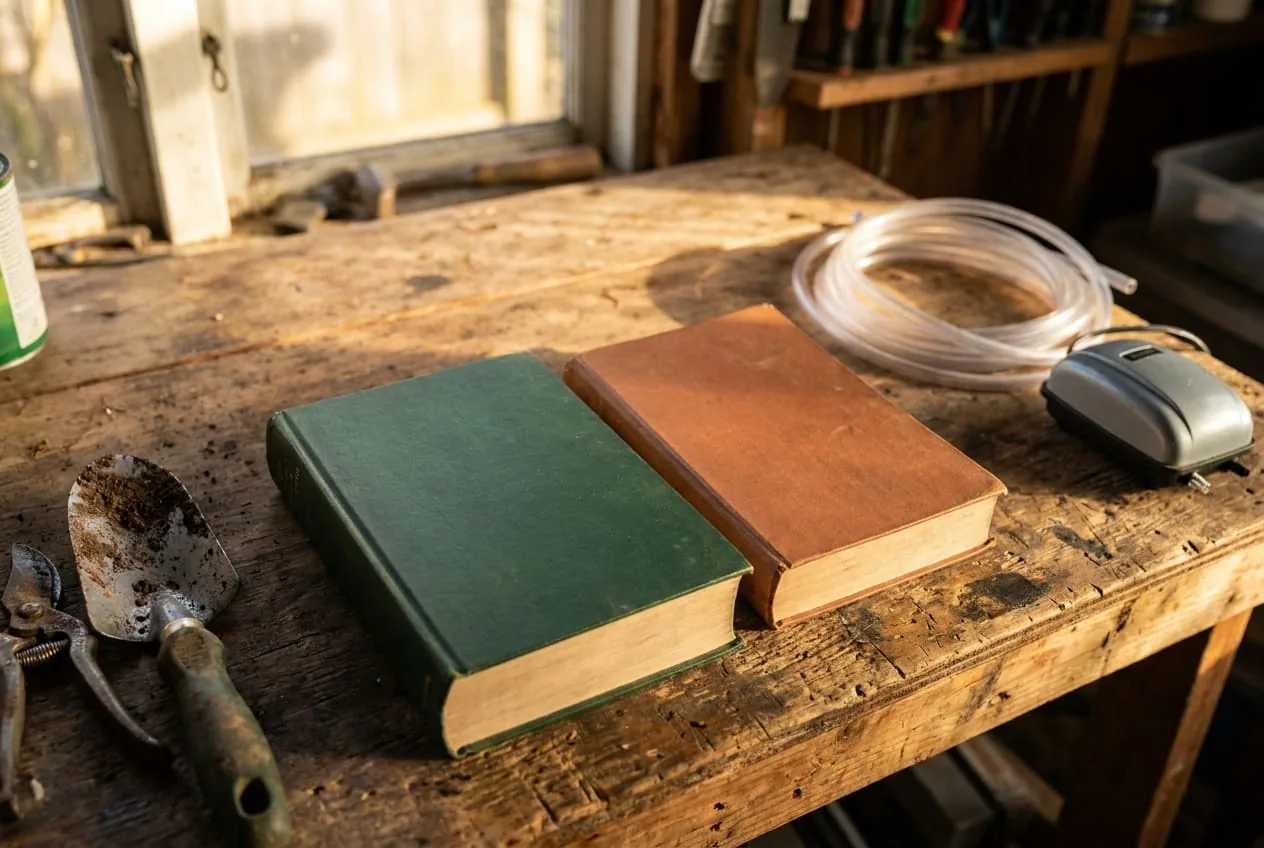
If you’ve watched one homesteading video this month, the retargeting machine has probably shown you both of these. The Self-Sufficient Backyard vs. Backyard Liberty is a comparison worth making carefully, because from the outside the two products look like siblings — both sold through ClickBank, both wrapped in dramatic video sales letters, both promising backyard independence. Underneath, they’re very different purchases: one is a 265-page general homesteading manual by two verifiable off-grid veterans; the other is a $39 digital guide focused on one thing — a small aquaponics system.
Standard disclosure first: we analyzed both products’ sales pages, publisher and retail listings, and independent reader reports. We have not built either system through a growing season ourselves, and both links on this page are affiliate links (see the banner above). With that on the table, here’s how they actually compare.
Short answer: For almost everyone, The Self-Sufficient Backyard is the better buy — it’s a 265-page manual with 75+ projects by two verifiable off-grid veterans, backed by a real ISBN and Goodreads ratings. Backyard Liberty is a $39 aquaponics-only guide from a disclosed pen name, sold, as far as we could find, nowhere but its own funnel, and only worth it if compact aquaponics is the specific gap you want to fill.
Self-Sufficient Backyard vs. Backyard Liberty: Side-by-Side
| The Self-Sufficient Backyard | Backyard Liberty | |
|---|---|---|
| What it is | 265-page homesteading manual, 75+ projects | Digital guide to a small “pocket farm” aquaponics setup |
| Scope | Food, water, power, preservation, medicine | Aquaponics (fish + plants), plus bonus PDFs |
| Authors | Ron & Johanna Melchiore — real, documented, ~40 years off-grid | ”Alex Deacon” — the sales page’s own fine print states the name is a pen name |
| Sold outside the funnel? | Yes — real ISBN; carried by Amazon and the Mother Earth News store | No — ClickBank funnel only, as far as we could find |
| Price | $37 typical (PDF; paperback optional) | $39 (listed as marked down from $89) |
| Refund | 60-day ClickBank guarantee | 60-day ClickBank guarantee |
| Best for | Building a broad, self-sufficient backyard step by step | Curiosity about one compact aquaponics build |
That author row is the comparison in miniature, so let’s take it slowly.
Which Author Can You Actually Verify?
The Self-Sufficient Backyard is written by Ron and Johanna Melchiore, and their history checks out in public records that have nothing to do with selling books: off-grid since 1980, including seventeen years on a remote lake in northern Saskatchewan, a memoir, work published in Mother Earth News, and an appearance in the documentary Life Off Grid (inthewilderness.net). The book has a real ISBN and sits in mainstream homesteading catalogs such as the Mother Earth News store (Mother Earth News Store). We went through the verification in detail in our full Self-Sufficient Backyard review — it scored 8.5/10, with the deductions going to the overheated marketing, not the content. (The fuller human story is worth a read too: the couple who spent 40 years off-grid — and the manual they left behind.)
Because it has a real ISBN, The Self-Sufficient Backyard is also available on Amazon as a paperback. That means you can comparison-shop the price, read reviews from verified purchasers, and buy under Amazon’s return policy instead of the ClickBank guarantee.
Backyard Liberty is credited to “Alex Deacon” (spelled “Alec” in the sales letter). Here we don’t need to speculate, because the product’s own website does the work: the fine print on the current sales page states outright, “Alex Deacon is a pen name” (Backyard Liberty). That’s not automatically disqualifying — publishing under a pen name is legal and common — but it means the “author’s story” in the sales video is marketing, not biography, and there’s no independent track record to check. When a book’s core promise is trust my experience, an unverifiable author is a real cost.
What You Actually Get
The Self-Sufficient Backyard is a project catalog: greenhouse designs, planting calendars, rainwater systems, small-scale solar, root cellars, herbal remedies, and dozens more (official book page). Its weakness is the mirror of its strength — 75+ projects in 265 pages means some chapters are primers rather than complete blueprints.
Backyard Liberty, in its current form, is sold as a “4ft Pocket Farm” — a compact aquaponics system where fish waste feeds plants and plants clean the water, pitched as producing food “on autopilot.” Aquaponics is a real and genuinely interesting method. In practice, it is also the opposite of autopilot at small scale: you’re keeping fish alive, balancing water chemistry, and buying fish feed — effectively adding a livestock project to get a vegetable project. As a first step toward backyard self-sufficiency, it’s a strange place to start; most growers get more food per dollar and per hour from soil, as our ranked list of first backyard projects lays out.
What Aquaponics Actually Takes
Because Backyard Liberty sells one specific system, it’s worth being clear-eyed about what running that system actually involves before you buy the guide. Aquaponics couples a fish tank to a grow bed: fish produce ammonia, bacteria convert it to nitrate, and plants take up the nitrate while cleaning the water for the fish. It’s elegant when it works. It’s also a living system with several ways to fail.
You’re keeping fish alive, which means monitoring water temperature, pH, ammonia, and nitrite — especially during the weeks-long “cycling” period before the bacterial colony is established and the system is stable. You’re buying fish feed, which is the input that quietly makes the “free food” framing misleading. And most designs rely on a pump running around the clock, so a power cut is a genuine risk to the fish unless you have a battery or air-stone backup.
None of that makes aquaponics a bad idea — it’s a real, productive method that a lot of people enjoy. It just isn’t the low-effort, set-and-forget system the sales page implies, and it’s an unusual first project for someone new to growing food. If you’ve read that honestly and still want to try it, start with a proper kit rather than improvising from a plans PDF:
Which Is Better Value for Money?
At $37, The Self-Sufficient Backyard costs about 50 cents per project, and even if you only ever build from its strongest third, independent reader feedback suggests you’ll find enough substance to cover the price. It also exists beyond the funnel — you can comparison-shop the paperback on Amazon at ordinary retail prices.
At $39, Backyard Liberty costs slightly more for a guide to a single system you may never build, from an author you can’t look up, available, as far as we could find, nowhere except its own sales page. The 60-day ClickBank refund applies to both products equally, so the risk isn’t the money so much as the shelf space in your plans.
Our verdict is not close: The Self-Sufficient Backyard is the better purchase for almost everyone reading this comparison. The honest case for Backyard Liberty is narrow — you’re specifically curious about compact aquaponics, you understand you’re buying one experiment rather than a roadmap, and you’d rather pay $39 for a packaged version than assemble free university extension guides on the same subject.
If you’ve already got the gardening fundamentals covered and aquaponics is the specific gap you want to fill:
Who Each Book Is Actually For
If you’re starting from zero and want the widest set of skills for your money, The Self-Sufficient Backyard is the clear pick. Its 75+ projects give you somewhere to go for years, and the soil-first, low-tech builds — raised beds, compost, rainwater, root cellars — return more food per dollar and per hour than aquaponics does at small scale. Two cheap purchases turn its early chapters into a working garden:
Backyard Liberty only makes sense for a narrower reader: someone who already has the gardening basics handled, is specifically curious about compact aquaponics, and understands they’re buying one experiment rather than a roadmap. For an apartment dweller with no yard, neither book is a perfect fit — but the aquaponics angle is at least buildable indoors, which is the one situation where Backyard Liberty’s narrow focus becomes an advantage.
FAQ
Is Backyard Liberty a scam? We found no evidence of a scam in the criminal sense: it’s a real digital product, delivered on payment, sold through ClickBank with a standard 60-day refund. It is, however, aggressively marketed under a pen name — a fact its own fine print discloses — and its “food on autopilot” framing undersells how much attention a live aquaponics system needs. Adjust expectations accordingly.
Is The Self-Sufficient Backyard worth the money? Based on our analysis of the authors’ verifiable 40-year record, the book’s mainstream retail presence, and independent reader feedback, yes — it’s the rare ClickBank-marketed book with genuine substance behind the funnel. Our full review breaks down which chapters deliver and which oversell.
Can you do aquaponics as a beginner? Yes, but go in with open eyes: you’re managing fish health, water chemistry, and feed costs on top of plant care. Many university extension programs, such as the University of Hawai’i’s, publish free aquaponics guides (University of Hawai’i CTAHR) that are worth reading before you buy anyone’s paid system. For first projects with faster payback, soil beds and compost beat aquaponics on almost every measure.
Do both books have refunds? Yes — both are ClickBank products with the standard 60-day money-back guarantee; ClickBank’s published policy says it will, at its discretion, allow the return of any product within 60 days of purchase (ClickBank).
Is The Self-Sufficient Backyard available on Amazon? Yes. Unlike Backyard Liberty (ClickBank-only), The Self-Sufficient Backyard has a real ISBN and is carried on Amazon as a paperback. You can check the current Amazon price here and compare it against the ClickBank PDF offer.
Frequently Asked Questions
- What is the difference between Self-Sufficient Backyard and Backyard Liberty?
- The Self-Sufficient Backyard is a 265-page general homesteading manual with 75+ projects covering food, water, power, preservation, and medicine, written by verifiable off-grid veterans Ron and Johanna Melchiore. Backyard Liberty is a $39 digital guide focused on a single compact aquaponics 'pocket farm' setup, credited to a pen name. One is a broad roadmap; the other is one experiment.
- Which book is better, Self-Sufficient Backyard or Backyard Liberty?
- For almost everyone, The Self-Sufficient Backyard is the better purchase. It has real, documented authors with roughly 40 years of off-grid experience, a genuine ISBN, mainstream retail presence, and 75+ projects for about 50 cents each. Backyard Liberty only makes sense if you are specifically curious about compact aquaponics and understand you are buying one build, not a roadmap.
- Are both books sold on ClickBank?
- Yes. Both are sold through ClickBank, whose published policy allows returns within 60 days of purchase at its discretion. The key difference is that The Self-Sufficient Backyard also exists beyond the funnel with a real ISBN on Amazon and in homesteading catalogs, while Backyard Liberty, as far as we could find, is available only through its own sales page.
- Is Backyard Liberty written by a real author?
- The product's own sales page fine print states that 'Alex Deacon' (spelled 'Alec' in the sales letter) is a pen name. Publishing under a pen name is legal and common, but it means the 'author's story' in the sales video is marketing rather than biography, with no independent track record to verify.
Sources & references
- Ron and Johanna Melchiore, About us (inthewilderness.net) (opens in new tab)
- Mother Earth News Store, The Self-Sufficient Backyard (opens in new tab)
- The Self-Sufficient Backyard, official book page (opens in new tab)
- Backyard Liberty, Pocket Farm sales page and fine print (opens in new tab)
- ClickBank, Return and subscription cancellation policy (opens in new tab)
- University of Hawai'i CTAHR, Aquaculture and aquaponics publications (opens in new tab)
Before you go
The Renter's Homestead Pack
Self-reliance projects for the yard you don't own — container yields, a raised bed built to move with you, balcony preservation basics, and the landlord questions to ask first.
Free guide
The Renter's Homestead Pack
Self-reliance projects for the yard you don't own — container yields, a raised bed built to move with you, balcony preservation basics, and the landlord questions to ask first.